
Administrator guide
For Owners and Managers who configure the business. It covers Settings, modules, roles, team, billing, and your security/privacy responsibilities.
Required permissions: Edit business settings & branding (
settings.manage) for Settings; Manage plan & billing (billing.manage) for billing; Add / edit team members and Manage roles & permissions for the team.
1. Business settings
Settings → General. Settings is organised into tabs, and each tab answers one
question. Modules comes first because it decides which of the other tabs you
even see; the screen still opens on General.
General
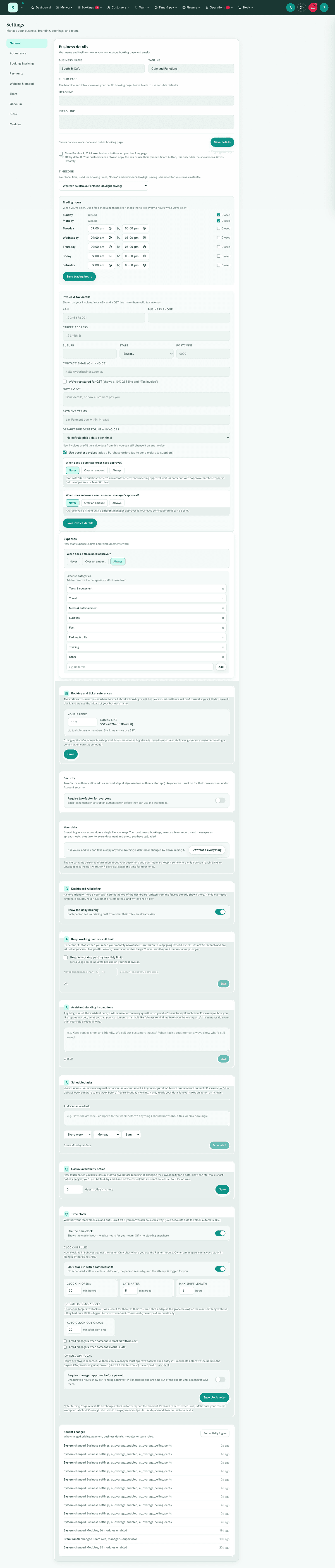
Who you are, when you're open, and the details that appear on your booking page and emails.
- Business name and tagline.
- Opening / trading hours, used by availability and the calendar.
- Timezone, make sure this is correct; "today", schedules and digests depend on it.
- Daily email, the morning digest: turn it off for the whole business, or
change the hour it arrives (your local time). If you have the Reminders tool
on,
Operations → Remindershas the same switch plus which days it goes out and what goes in it.
Invoicing & tax
How the paperwork behaves, split out of General because both of these are long and neither is about who you are. Appears once Invoicing, Expenses or Payments is on.
- Business & tax details, your ABN and GST-registered status. These appear on invoices and receipts, and drive GST handling in Invoicing and the Accounting & reports.
- How to pay and the default payment terms new invoices start from.
- Closing off a period, a lock date so nothing can be changed behind a lodged BAS.
- Purchase orders, whether you use them and when one needs approval.
- Invoice approval, whether a large invoice needs a second manager.
- Expenses, the approval rule and your category list. Set approval to Never if it is just you.
Connections
What outside services the business is linked to, and the one place to connect or disconnect them. Appears once Payments, Accounting & reports or Pay run is on.
- Xero, which organisation you are connected to, with Connect, Reconnect and Disconnect. Whoever connects logs in at Xero and chooses the organisation, so everything lands in your own books. Connecting is not the whole job, so under the connection each part reports for itself: Accounting (what goes to Xero and whether it goes by itself, set up on Accounting & reports) and Payroll (whether timesheets can be sent yet, with the steps still to do listed in order, set up on Pay prep & export). A part that is not finished is marked and has a button to the page where it is finished. Setup, step by step opens one screen that does the whole thing in order, connecting included, and ticks each step off as it is saved; it can be left and picked up again. Disconnecting stops anything more being sent and keeps your mapping and matches.
- Stripe, connected and taking card payments or not yet, with a button to Payments where it is set up.
AI
- Dashboard AI briefing, the short "here's your day" note on your dashboard.
- Keep working past your AI limit, pay-as-you-go and the spend ceiling.
- With the Assistant on: standing instructions and scheduled asks.
Data & security
Who can get at your information, and what happened to it.
- Security, whether two-factor sign-in is required for your whole team.
- Your data, download a complete copy of everything you have, any time.
- Recent changes, who changed pricing, payment, business details, modules or team roles, with a link to the full activity log.
Appearance (branding)
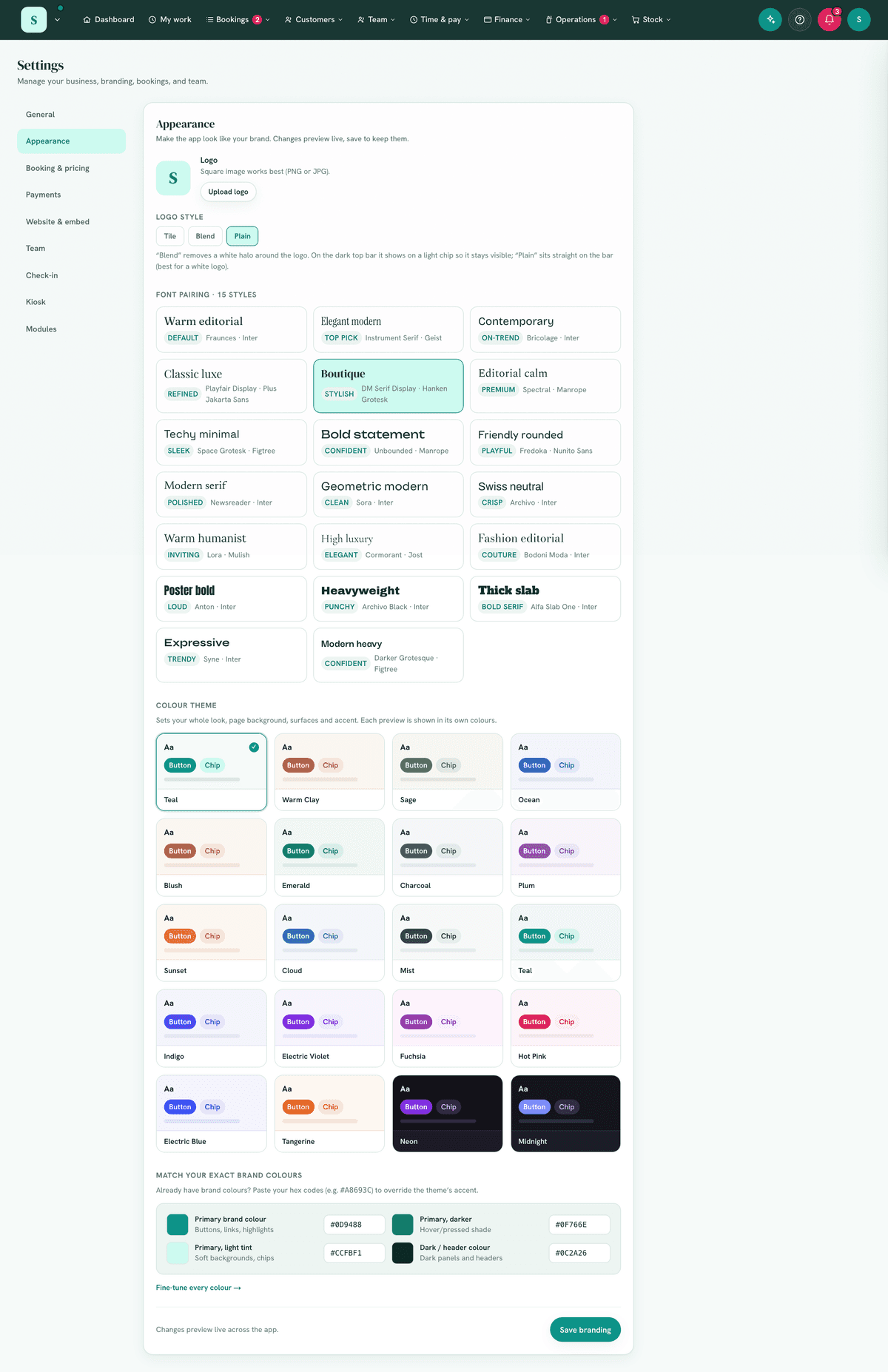
- Upload your logo and set its presentation style.
- Set your brand colours and fonts so the back-office and your public booking page feel like your business.
Wording (make it yours)
These wording controls do not sit in a tab of their own. They live inside the General tab and your booking/pricing tab (the one named after your booking word).
- What you call a booking (appointment, class, party, job, lesson…) and the people in it (clients, guests, members, patients…).
- The Recipes word (recipe, menu, service, product) and its unit.
- These flow through menus, pages and the AI assistant automatically.
Team
- Invite and manage staff (also at
Team → Staff list). - Mark yourself a solo operator to hide "invite your team" prompts.
- Time clock, whether your team clocks in and out, and the clock-in rules (rostered-shift requirement, early window, late grace, max shift, auto clock-out). This is separate from the Roster module: turning Roster off does not turn off clocking, and this switch works whether or not you use it.
- With Roster on: shift roles, the clock geofence, and the casual availability notice period.
Modules
- The Settings tab named Modules (not "Tools"): the on/off switch for every module, grouped (Assistant; Bookings; Customers; Team; Time & pay; Finance; Operations; Stock).
- Turn on only what you need; switching is instant and reversible. Modules outside your plan are locked.
Per-feature flags: some modules have their own sub-toggles (e.g. Invitations & run-sheet's digital invitations, run-sheet, kitchen timing; deposit/pricing defaults; the booking opt-in prompt). Look within the relevant area's settings.
2. Modules & plans
- Plan controls which modules you may switch on; Settings → Modules controls which you actually use.
- Check Plan & billing for your live plan, price, team-member limit and inclusions, and to upgrade/downgrade.
- Solo = single-operator day-to-day toolkit; Business = everything, with 20 team members included and extra seats available to buy. (These names and contents are set by your provider and can change.) See Getting started › Plans.
3. Roles & permissions
Team → Staff list.
- Built-in roles: Owner (always full access, not editable), Manager, Supervisor, Staff, all but Owner are adjustable; create your own roles too.
- Permissions are fine-grained and only appear for modules you have on.
- Principle of least privilege: give each role only what it needs. Keep at least one trusted Owner.
- Full catalogue: User roles & permissions.
4. The team directory
Team → Staff list.
- Add staff, set each person's role, and manage access.
- Add member offers three ways in: Send invite (they pick Google, Microsoft or their own password), Set password (you hand them a temporary one), or No login (a record for someone who does not use the app).
- Someone with no email address? Choose No login and tick "…doesn't have an email address". They are still rostered, still accrue leave, still hold certifications, and they clock in and out on the kiosk with their own PIN, so their hours reach timesheets and payroll like anyone else. The only thing they miss is email, so no roster or leave-decision messages go out; their card says so rather than leaving you guessing. Add an address later and the emails start.
- Someone with no login cannot be made the owner: an owner who cannot sign in would lock the business out. Give them a login first.
- Removing someone's access shows them an "Access removed" message rather than deleting their history.
- New staff given a temporary password set their own on first login.
- Files on their record: each person's profile has a Files section for their CV, signed contract, ticket or visa copies (PDF, Word or an image, up to 10 MB each). Files are private, open through short-lived links, and only people who can manage the team see them. Hiring someone from a job application form copies the application's documents in here automatically, badged "From application". A member with files on record can't be deleted until the files are removed, the same as any other employment record.
5. Billing & lifecycle
Plan & billing.
- See trial status / days remaining, current plan and what's included.
- Subscribe, upgrade or downgrade.
- If billing lapses, the back-office locks (data preserved) until reactivated.
- Account-level suspension is operator-controlled; contact support if you see "Account paused".
6. Security & privacy responsibilities
HappierBiz is built security-first, but you control how your business uses it:
- Least-privilege roles. Don't give everyone Manager. Review roles periodically and when staff leave.
- Remove access promptly when someone leaves (Team → Staff list). They lose access immediately; their records remain as history.
- Sensitive files belong in Documents (private storage + expiring links), not public buckets or shared drives. Documents also carries its own access layer: put HR files, contracts and pay records in their own folder and set who can see it (Operations → Documents, the settings icon on that folder's card, then Who can access), describing it in plain English and letting AI propose the rules if you would rather not think in permissions. Least privilege applies to files as much as to screens.
- Banking & identity details for payments are entered on Stripe's secure pages, never collect or store them elsewhere, and never share them in chat or email.
- Marketing consent must be genuine, never pre-tick or assume it. The system records when/how consent was given; honour unsubscribes (handled automatically).
- Data isolation is automatic, no other business can see your data, but your internal access control is up to your role setup.
7. Data & records
- Customers are derived from bookings/invoices; deleting a customer removes notes/tags but keeps booking/invoice history as a business record.
- Leave balances are indicative only, your payroll system (e.g. Xero) is the source of truth.
- Timesheets export to a payroll CSV; invoices export to an accounting CSV (Xero/MYOB/QuickBooks).
- Safety keeps an exportable audit trail.
8. Recommended admin routine
| Cadence | Do this |
|---|---|
| Daily | Scan the dashboard Needs attention; approve booking/shift/leave requests. |
| Weekly | Approve timesheets; review the morale read; clear the reminders digest. |
| Monthly | Export accounting; check expiring certifications; review roles & access. |
| As needed | Update branding/wording; turn modules on/off; manage the team. |
Related: Quick-start · Roles & permissions · Troubleshooting