
Module · Invoicing
Where to find it in the app
- Use it: Finance → Invoicing
- Turn it on/off: your business name (top-left) → Settings → Modules → Finance → Invoicing
Plan: Solo and Business · Module group: Finance · Navigation:
Finance → Invoicing
1. Overview
Purpose. Raise invoices to bill customers and track what's owed, and send quotes (priced proposals) you can convert into invoices once accepted. It also handles outbound purchase orders to your suppliers, raise, approve, send and receive them from the same place (see 7g). It feeds the dashboard's Money, Business health, and the Accounting & reports.
2. When to use it
- To bill a customer beyond (or instead of) a booking deposit.
- To send a priced quote and turn the accepted ones into invoices.
- To keep a running picture of outstanding income.
3. Required permissions
- View invoices (
invoicing.view). - Create / send invoices (
invoicing.manage). - Raise purchase orders (
po.request), see the Purchase orders tab and raise POs, without needing full invoicing access. - Approve purchase orders (
po.approve), approve or reject POs awaiting approval (includes raising).
4. Navigation path
Finance → Invoicing
5. What you'll see
Tabs, in order: Ready to bill (when the Jobs tool is on, with a count of customers who have finished work waiting for an invoice), Invoices, Quotes, Purchase orders (when switched on and your role allows), and Receipts. Ready to bill leads because it is the one tab that is a to-do list; the page still opens on Invoices.
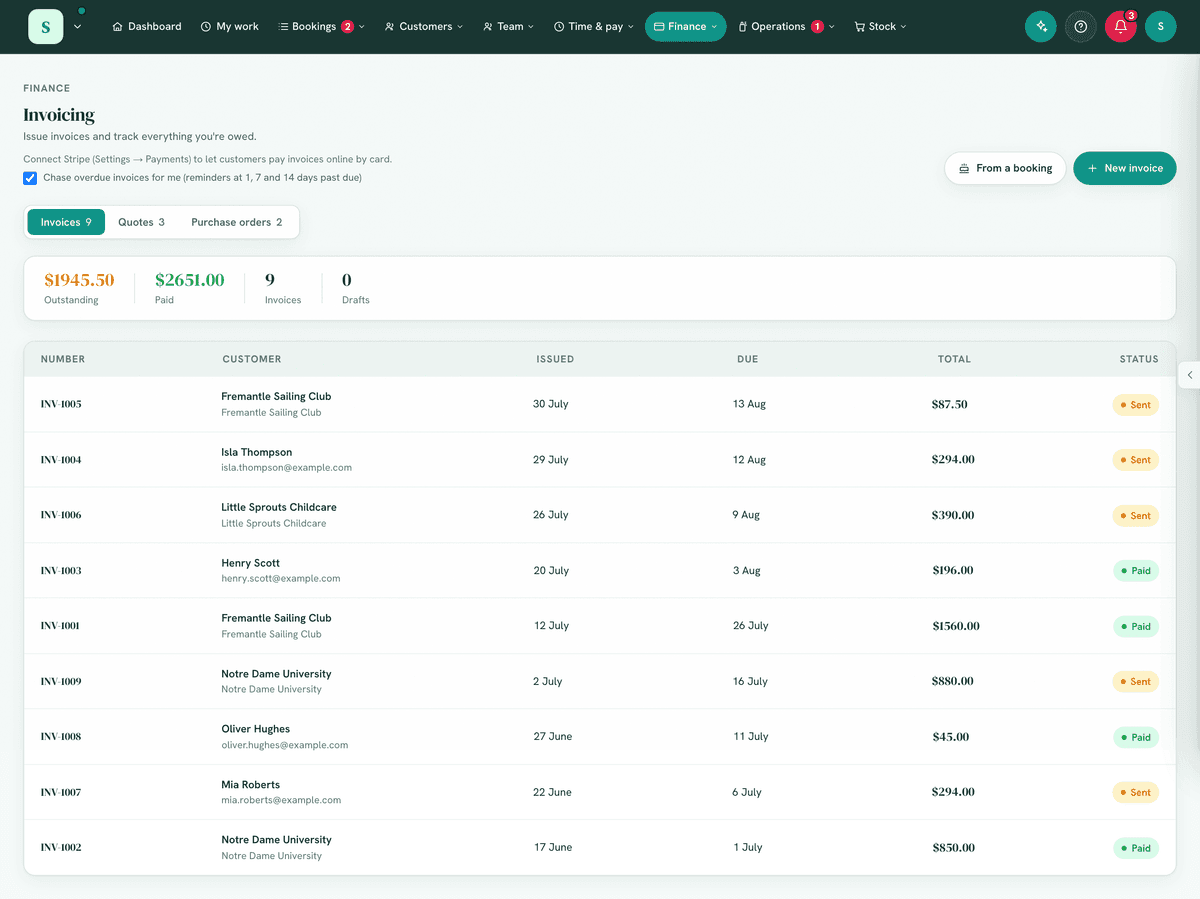
A stats band: outstanding (sent, unpaid), paid total, accepted total (quotes), the number of documents issued, and drafts. Every figure says which period it covers.
Outstanding is always all time, because a debt does not stop being owed when the month ends. The other figures follow a period the business chooses: This month, This quarter (the same ATO quarter your BAS page uses), This financial year (1 July to 30 June), or All time. Owners and managers pick it from the Period control on the band; it is one setting for the whole business, so everyone reads the same numbers. A document belongs to a period by its issue date.
Invoices counts documents that were issued and are still live. Drafts have their own figure and voided documents are not counted, so the numbers on the band never include the same thing twice.
Filter chips above the list, each with its live count: on invoices, All, Drafts, Awaiting payment, Overdue and Paid; on quotes, Awaiting reply, Accepted and Declined; on purchase orders, Awaiting approval, Open and Received. Overdue means sent with a due date now in the past, so an invoice saved without a due date is never counted overdue.
A search box on every tab: type part of a document number or a customer, company or email (supplier on purchase orders) and the list narrows as you type. The list shows the newest 50 matches with a Load more button for the rest, and the stats band always covers everything, not just the rows shown.
A list of documents with number, customer, due date, total and status. An invoice past its due date wears Overdue in place of Sent, and one saved without a due date says No due date rather than showing a blank.
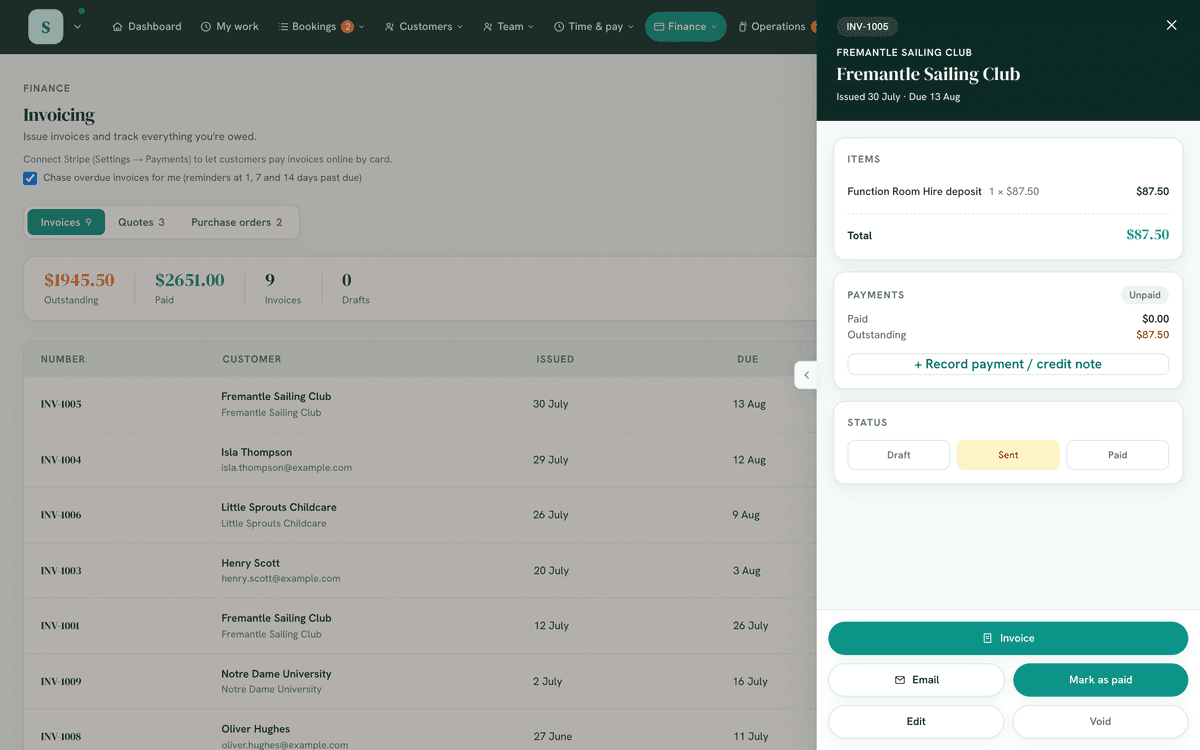
Selecting one opens its detail (line items, totals, payments and actions); each document also has its own page.
A document raised for a booking says so under its dates: From booking SSC-2026-… with the booking's date. It is a link back to that booking when your role can view bookings, and plain words otherwise. The same link runs the other way from the booking's own drawer.
Status moves by itself. The drawer shows each document's journey as a trail (for an invoice: Draft → Sent → Paid) with the finished steps ticked. You never set these by hand:
- Invoices: Draft → Sent → Paid. Emailing the invoice marks it sent (or press Mark as sent if you handed it over outside the app), and recording a payment marks it paid (see 7b).
- Quotes: Draft → Sent → Accepted / Declined. Emailing marks it sent; it becomes accepted or declined when your customer answers the quote link, or when you press their answer. An accepted quote can become an invoice.
- Purchase orders: Raised → Sent → Received, with Requested → Approved / Rejected in front when your approval rule requires it (see 7g).
- Receipts: none. A receipt is a finished record of money you have already taken.
Receipts
When a customer pays, the app emails them a receipt and keeps a copy here, numbered
REC-0001 upwards. You never raise one: they appear when money arrives, from a booking
deposit, a balance, a payment you key in, a cancellation fee, or membership dues.
You can read one, print or save it as a PDF, and send it again to any address. You cannot edit, delete or void one, because it records what actually happened.
Your customer can print their own copy. Every receipt email carries a private link to it, so when somebody asks for the PDF months later they do not have to go looking through their inbox: they open the link and press Print or save as PDF. It is the same document you sent them, and it takes no payment and changes nothing.
If a customer rings up asking for a copy, open the receipt and press Copy link for the customer to paste it into a text message.
Prefer receipts to live only in the inbox they were emailed to? Untick Let customers print their own receipt at the top of the Receipts tab. While it is off no receipt link opens, including any you have already sent.
⚠️ Receipts are not invoices and are never counted as income twice. They are left out of Outstanding, your GST reports, the aging list, the invoice chase and the Xero push. The tab's one figure, Received, is the money that actually landed.
Full detail, including what makes a receipt a valid tax invoice, is in Payments sections 7d and 7e.
6. Turning it on
Settings → Modules → Finance → Invoicing. Add your business and tax
details (ABN, GST registration) in Settings → Invoicing & tax so they appear on documents and
drive GST handling.
7. Step-by-step tasks
7a. Create an invoice
- On the Invoices tab, create a new invoice.
- Set the customer, add line items (description, quantity, unit price), a due date and any notes.
- Save as Draft, then Send when ready. Amounts are GST-inclusive when your business is GST-registered.
7b. Mark an invoice paid
- Open the invoice.
- In Payments, press Mark as paid (prefilled with the amount owing and today's date) or Record a part payment, refund or credit note, say how they paid, and press Record. The invoice flips to Paid by itself, the customer is emailed their receipt, and a copy is filed on the Receipts tab.
- There is deliberately no way to set the status to Paid by hand: the amount, date and method go on file with every payment, because that is what the receipt, your BAS figures and the accounting export are built from. An invoice paid by card through its pay link records all of this on its own.
7c. Send a quote and convert it
- On the Quotes tab, create a quote with line items and send it.
- When the customer accepts, mark it Accepted (or Declined if not).
- From an accepted quote, create an invoice, it carries the lines over and jumps you to the Invoices tab.
Or let them accept it themselves. Turn on "Let customers accept quotes online" at the top of the Quotes tab, and every quote you email carries an Accept this quote button. When the customer types their name and accepts:
- the quote moves to Accepted by itself, and records who accepted it and when, which you can read on the quote,
- a job opens for the work, numbered and linked back to the quote,
- owners and managers are told straight away, in the app and by email, with the customer's name, the amount and the job number,
- and the customer is emailed a confirmation that their acceptance has been received, with their job reference.
The customer's confirmation goes to the email address on the quote, not to whoever pressed the button, because that is your customer of record. A quote with no email address on file (you can copy the accept link and send it by hand) simply has nobody to confirm to.
Accepting takes no payment and asks for no card. The invoice comes later, from the work actually done. Only a quote you have sent can be accepted, and only until its valid-until date passes.
7d. Set a default due date for new invoices
To stop typing the same due date every time, set a default in
Settings → Invoice details → "Default due date for new invoices". Choose
Custom date, Due on receipt, Net 7 days, Net 14 days or Net 30
days. Every new
invoice then pre-fills its due date from this, you can still change it on any
individual invoice. Quotes are unaffected, and editing an existing invoice
keeps its stored date.
7e. Copy an invoice's online pay link
If you take card payments online (Stripe connected, online card payment on), open
an invoice (Finance → Invoicing → open an invoice) and use Copy pay link in
the drawer. It copies the customer's secure online card-payment URL to your
clipboard, so you can paste it into an email or message. The button appears on
invoices that aren't void or paid.
7f. Refund a payment
In the invoice drawer's Payments card, each recorded payment has refund options:
- Refund to card, shown on an online card payment row (for users with
the Refunds permission,
payments.refund). It issues a real Stripe refund on your connected account, full or a partial amount, records it in the ledger, and reopens the invoice if it's no longer fully paid. - Refund, records a manual (cash/eftpos) refund in the ledger without touching a card. Use this when you handed money back in person.
Partial refunds are supported. Enter any amount up to what's left of the payment. A partially refunded payment is tracked as partially refunded, and you can refund it again later, up to the original amount, never past it.
7g. Raise & approve purchase orders
Purchase orders (POs) let you order from suppliers with a paper trail,
useful for a head chef or ops person who orders stock but doesn't touch
customer invoicing. Switch them on (and set the approval rule) in
Settings → Invoice details.
Raise a PO.
- On the Purchase orders tab, create a new PO and pick the supplier from your supplier book (shared with the Shopping list; PO approvers can add or edit suppliers here, name, email, ABN, account reference and more).
- Add line items, or pre-fill from Shopping: the PO pulls in that supplier's needed / on-order items from the shopping list so you don't retype them.
- Optionally set an expected date, reference and notes, then save. POs get their own PO- numbers.
Approval (optional). In Settings → Invoice details you can require
approval for POs: off, over a threshold amount, or always. When a
rule applies and the raiser can't approve, the PO is parked as Requested
until someone with Approve purchase orders approves it (it becomes
Approved, ready to send) or rejects it with a note.
Two-step sign-off (optional). If your business has turned on two-step approvals, a PO that needs approval takes two approvals: an approver confirms the order first, then a Payroll Officer does the final sign-off that clears it to send. A PO mid-way carries a "Payroll sign-off" tag and appears in the Approvals inbox alongside leave, timesheets and expenses. (A raiser who can approve skips their own manager check.) With two-step off (the default), the approval above is a single decision.
Send it. Send emails the PO to the supplier (the supplier needs an email address). A requested or rejected PO can't be sent.
Mark it received. When the goods arrive, mark the PO Received: tick off which lines were actually supplied, correct any actual prices, and attach the receipt (stored privately). Received POs are locked like paid invoices, cancel it and raise a new one if something's wrong.
Where POs flow. Received POs can be exported from Accounting as a bills (accounts payable) CSV for your bookkeeper. POs never mix into your sales figures or the sales export.
Telling customers how to pay you
Every invoice ends with a How to pay block, and it says the same thing wherever the customer is looking: on the emailed invoice, on the printed or PDF'd copy, and on the online invoice they open from the link. It lists whatever you have set up, in this order:
- Pay by card, offered automatically whenever Stripe is connected and online card payment is on. There is nothing to type. On the printed copy this is a QR code, so a posted invoice is still payable from a phone.
- Pay by bank transfer, from the account name, BSB and account number you set in Settings → Invoice & tax details. Customers are also told to quote the invoice number as the reference, which is what lets you match the deposit to the invoice later. You never type that, it comes from the invoice itself.
- Any other way to pay, free text for anything the fields don't cover: cash or card in person, cheque, an account with a wholesaler.
Your BSB is checked. A BSB is six digits (633-000). If you type four, the
save is refused and says so. This is not fussiness: a wrong BSB is a customer's
payment that silently never arrives, and you are the last person who finds out.
For the same reason, the three bank fields are all-or-nothing, half an account
on an invoice is worse than none.
When it's due
Under How to pay, every invoice prints its deadline as a date:
Payment due by 8 August 2026.
That sentence is taken from the invoice's own Due date, so it can never disagree with the "Due" line further up. Wording like "payment within 14 days" is deliberately not used: fourteen days from when? The invoice is issued one day, emailed the next, opened days later, and a posted one arrives a week after that. Everyone counts from somewhere different and none of it is written down. A date can't be counted wrong, and it's what you point at when you chase.
Set the deadline in Settings → Invoice & tax details → "Default due date for new invoices", or per-invoice in the Due date box. An invoice with no due date states no deadline at all and can never be counted as overdue, so the editor warns you when it's empty.
The "Anything else about paying" box is for conditions the date can't express ("Late payments may incur a fee"). It prints under the deadline. It is not where you set the deadline.
Only an owner or manager can change these. Where your money lands is the highest-value setting in the app, so it sits behind the same check as your ABN and business address, and every change is recorded in Settings → Activity log.
If you have set up none of the three, the Invoicing page warns you, and the customer's invoice tells them to contact you rather than pointing at payment details that aren't there.
8. Examples
- Beginner (tutor): raise a simple one-line invoice for a block of lessons, send it, mark it paid when the transfer arrives.
- Real-world (trades): send a multi-line quote for a job; on acceptance, convert it to an invoice and track it to Paid.
- Advanced (venue): invoice the balance of a function beyond the booking deposit, set a due date, then export paid invoices to Xero at month-end.
9. Reports & exports
- The stats band gives outstanding (all time) and paid/accepted/draft figures for the period the business has chosen, named on each figure.
- Sent and paid invoices (never quotes or drafts) flow into the Accounting & reports CSV.
- Outstanding invoices appear on the dashboard and in Business health.
10. Common mistakes
- Leaving an invoice as Draft, drafts aren't owed, counted or exported. Send it.
- Expecting quotes to export, only invoices do; convert accepted quotes first.
- Wrong GST treatment, set your GST-registered status in Settings so totals and the export are correct.
- No due date, overdue tracking needs one.
11. Troubleshooting
| Problem | Fix |
|---|---|
| An invoice isn't in the accounting export | It must be Sent or Paid (not Draft), and within your export date range. |
| Totals look wrong with GST | Check your GST-registered setting and that amounts are entered GST-inclusive. |
| Can't create or send | You need Create / send invoices. |
| A quote won't appear as income | Convert the accepted quote into an invoice. |
| New invoices have the wrong (or no) due date | Set a default in Settings → Invoice details → "Default due date for new invoices". It only fills new invoices; change any single invoice's date as needed. |
| No Copy pay link button | It only shows when online card payment is on, Stripe is connected, and the invoice isn't void or paid. |
| No Refund to card button | The payment row must be an online card payment, and you need the Refunds permission (payments.refund). For cash/eftpos, use the plain Refund (manual ledger entry). |
| "A BSB is 6 digits, like 633-000" | You've typed part of a BSB. It's the six-digit number at the top of your bank statement, usually shown with a dash in the middle. |
| "Bank details need all three parts" | Add the account name, BSB and account number. A partly-filled block would leave a customer unable to complete the transfer. |
| The Invoicing page says "Your invoices don't show any way to pay" | You have no bank details, no card payment and nothing written down, so every invoice you send names an amount and no way to settle it. Fix it in Settings → Invoice & tax details. |
| My invoice promises 14 days but is dated 30 days out | Your typed wording and your Default due date disagree, and the customer sees both. Settings warns you when they do; change whichever one is wrong. |
| The invoice doesn't say when payment is due | It has no Due date. Set one on the invoice, or set a default in Settings → Invoice & tax details. Without it there's no deadline to print and the invoice can never go overdue. |
| No Purchase orders tab | POs are switched off in Settings → Invoice details, or your role lacks Raise purchase orders / View invoices. |
| A PO won't send | It's still Requested (needs approval first) or was Rejected, or the supplier has no email address. |
12. Error messages
Status changes confirm inline (e.g. "Invoice sent", "Quote accepted",
"Created invoice
Related: Payments · Accounting & reports · Customers · Shopping list
Adjustment notes (credits and refunds)
When you record a credit or a refund against an invoice, an adjustment note is created automatically and numbered ADJ-0001 upward. Open it from the payments panel on the invoice, print it, or send it to the customer.
You need one. Where a credit or refund changes the GST on a sale, the law asks the seller to issue an adjustment note, and to do it within 28 days if the customer asks for one. It is what lets your customer undo the GST they claimed on the original invoice, so without it they are stuck.
The note shows the invoice total before, the amount credited or refunded, the GST inside that amount, and the total after. The GST is worked out as a share of the whole sale, so on an invoice that mixes taxable and GST-free items a $50 credit does not carry $4.55 of GST, it carries its proportion.
If you are registered for GST but have not saved a valid ABN, the note tells you so before you send it: without an ABN it cannot do the one job the customer needs it for.
When an invoice email does not arrive
Handing an email to the provider is not the same as it being delivered. If an invoice email bounces or is refused, the invoice now says so, in red, on the invoice itself: "This didn't reach [address]", with what the provider said.
This matters because everything downstream assumes it arrived. The due date runs, the invoice ages into overdue, and the automatic chasing keeps writing to the same dead address. Fix the address and send it again.
Sent date. The "sent" date is when the document FIRST went to the customer and does not move when you resend, because that is the date the payment clock ran from. Resending is recorded separately.