
Module · Team happiness
Where to find it in the app
- Use it: Team → Team happiness
- Turn it on/off: your business name (top-left) → Settings → Modules → Team → Team happiness
Plan: Business · Module group: Your team · Navigation:
Team → Team happiness
1. Overview
Purpose. Look after your people, not just the numbers. Team happiness offers an anonymous weekly pulse check-in, peer recognition (shout-outs), and an owner/manager morale read, because the goal is happier teams, not just efficient ones.
Anonymous by design. Pulse responses feed an aggregate morale figure; individual responses are not attributed. Managers see the team mood, not who said what.
2. When to use it
- To take the team's temperature each week.
- To recognise good work publicly.
- To give staff a safe channel for suggestions.
3. Required permissions
- View team happiness (
happiness.view). - Manage pulse & recognition (
happiness.manage).
4. Navigation path
Team → Team happiness
5. What you'll see
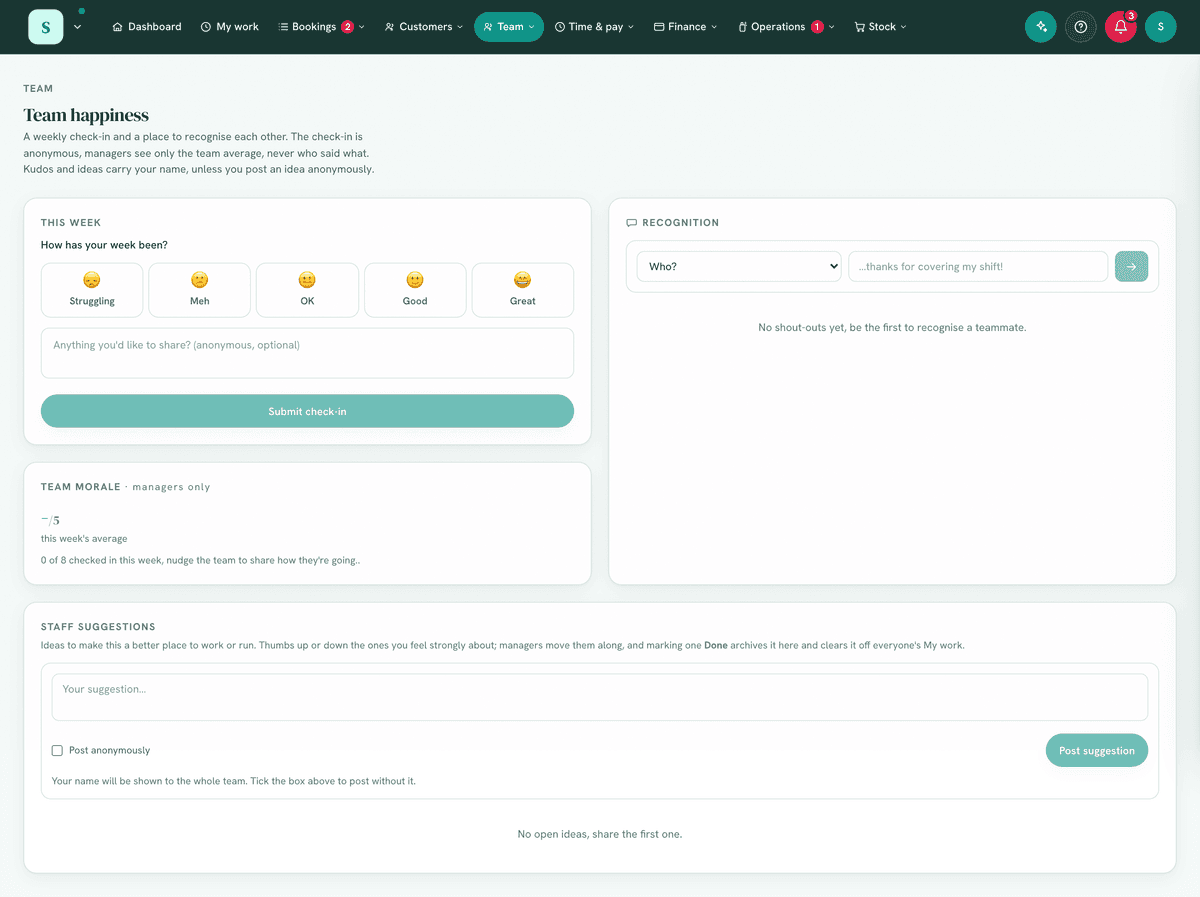
- This week, your own pulse check-in (a score, with an optional anonymous comment), and a "Change my check-in" option.
- Team morale (managers only), the aggregate read for the team.
- Recognition, give a team member a shout-out / thanks.
- Staff suggestions. Submit an idea or improvement (with your name or anonymously), upvote the ones you back, and follow each one's status.
6. Turning it on
Settings → Modules → Your team → Team happiness (Business plan).
7. Step-by-step tasks
7a. Do your weekly check-in (everyone)
- Open
Team → Team happiness. - Set your score for the week and, optionally, add an anonymous comment.
- Use Change my check-in to update it during the week.
7b. Recognise a teammate
- In Recognition, pick a team member and write a short message (e.g. "…thanks for covering my shift!").
- Post it so the team sees the appreciation.
7c. Read team morale (managers)
- Open Team morale (managers only).
- Review the aggregate trend; it also surfaces on the dashboard for managers.
7d. Submit a suggestion
- In Staff suggestions, write your idea and submit it, choosing whether to post with your name or anonymously.
- Anyone on the team can upvote the suggestions they support, so the ones with the most backing rise to the top.
- Managers move each suggestion through a simple status as they act on it: New → Considering → Planned → Done, or Not now, so the team can see where their idea landed.
8. Examples
- Beginner: the whole team does a 10-second weekly check-in; the owner sees morale trending up.
- Real-world (gym): trainers post recognition for great member feedback, and a dip in morale prompts a quiet check-in from the manager.
- Advanced: suggestions feed a monthly team meeting; recognition becomes part of the culture, and the morale read informs rostering and workload decisions.
9. Reports & exports
The team morale read (managers) is the headline metric and appears on the dashboard. Recognition and suggestions are living records.
10. Common mistakes
- Treating it as surveillance, it's deliberately anonymous; don't try to identify individual responses.
- Only the owner checking in, encourage the whole team so the morale read is meaningful.
- Ignoring the signal, a falling morale read is the point; act on it.
11. Troubleshooting
| Problem | Fix |
|---|---|
| Morale shows "Loading…" / nothing | There may be no responses yet this week; encourage check-ins. |
| A staff member can't check in | They need View team happiness, and the module on. |
| Can't manage pulse/recognition settings | That needs Manage pulse & recognition. |
12. Error messages
Check-ins, recognition and suggestions confirm inline. Morale only appears once there's at least one response for the period.
Related: Team comms · The dashboard & navigation