03 · The dashboard & navigation
This chapter explains the home Dashboard you land on after logging in, and the top navigation you use to move around the back-office.
The top navigation bar
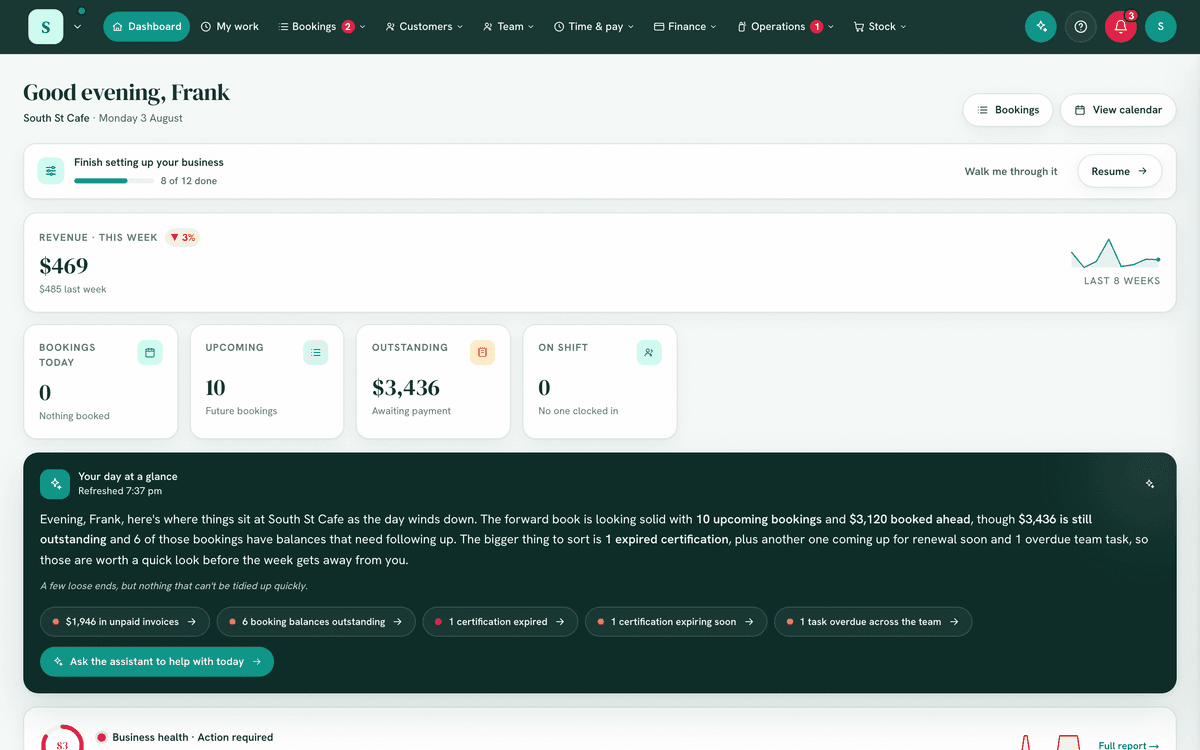
The dark bar across the top of every back-office page is your main navigation. From left to right:
- Workspace switcher, your business logo and name (top-left). Select it to switch between businesses you belong to, and to reach Settings and Plan & billing for the current business (shown if your role allows).
- Dashboard, a home link back to this page, and My work, your own day.
- Grouped menus, related tools collected into dropdown groups (below).
- More, holding any group that did not fit the width of your screen.
- Search everything, the magnifying glass. See below.
- Assistant, a sparkle icon (only if the AI assistant module is on and you have permission). Opens the AI assistant.
- Help, the ? button, opens the guide and the getting-started panel.
- Notifications bell, a live list of things needing attention.
- Account menu, your account, password and sign-out.
The navigation is personalised: you only see groups, menus and items your role can access and your business has switched on. A group with only one available item collapses into a single flat link. So two people in the same business can see different menus.
The navigation groups
| Group | Contains | Notes |
|---|---|---|
| (Dashboard) / (My work) | Dashboard, My work | Always present. Standalone links, not menus. |
| Bookings | Bookings, Services, Memberships, Check-in, Calendar, Day plan | The group label and its first item follow your wording (e.g. "Appointments", "Classes"). Day plan appears only when the run-sheet is switched on. Staff, spaces & equipment has no menu item on purpose, it is once-ever setup: reach it from the Services page or the getting-started checklist. |
| Customers | Customer list, Messages, Marketing | Messages is always available, even without the Customers module. |
| Team | Staff list, Announcements & chat, Licences & certificates, Team happiness | Roles & permissions is opened from the Staff list page, it has no menu item of its own. |
| Time & pay | Approvals, Roster & timesheets, Jobs, Time off & shifts, Pay prep & export | Approvals appears for approvers, and gathers leave, shift, timesheet, expense and purchase-order approvals into one inbox. Time off & shifts holds Leave and Shift swaps as sub-tabs. |
| Finance | Money owed, Invoicing, Accounting & reports, Expenses | |
| Operations | Tasks, Safety, Maintenance, Documents, Forms, Reminders, Equipment, Handy links | Business health has no menu item, you reach it from its dashboard card. |
| Stock | Shopping, Recipes | The Shopping and Recipes labels follow your wording (e.g. "Supplies", "Menu"). |
Settings and Plan & billing aren't in the top bar, they live in the workspace switcher (your business name, top-left). Open Settings there, then use its tabs (General, Appearance, Payments, Team, Modules, …) to set things up and switch modules on or off.
Search everything
The magnifying glass in the top bar searches the whole back-office at once, so you can reach a record without knowing which module holds it. Keyboard: ⌘K on a Mac, Ctrl+K on Windows. On a phone it is the first item in the More menu.
- Select the magnifying glass (or press ⌘K).
- Type at least two characters. Results appear as you type.
- Select a result to go straight to it, or use the arrow keys and Enter. Esc closes the panel.
It searches customers, bookings, invoices and quotes, documents, forms, tasks and your team. Customers, bookings and team members also match on a phone number: type at least four digits, and the leading 0 (or +61) is ignored, so the number finds them however it was saved.
Results are grouped by what they are, with the closest matches first: a name you typed in full beats a name that merely starts with it, which beats a match in the middle. Each group shows its best few, so a common surname cannot crowd out everything else.
You only ever see what your role already allows. Each kind of record is checked against your own permissions and against what your business has switched on, so the search cannot show you a record you could not have opened by navigating to it. Nothing is added to what you can see, it is only faster to reach.
If one kind of record cannot be searched right now, the panel says so for that group rather than showing it as empty, because "no results" and "could not look" are different answers.
The More menu
Menus that do not fit the width of your screen collect under More, on the right of the nav. Nothing is ever hidden: narrow the window and the groups move into More rather than running off the edge. On a phone the whole nav lives there, with Search everything at the top.
The notifications bell
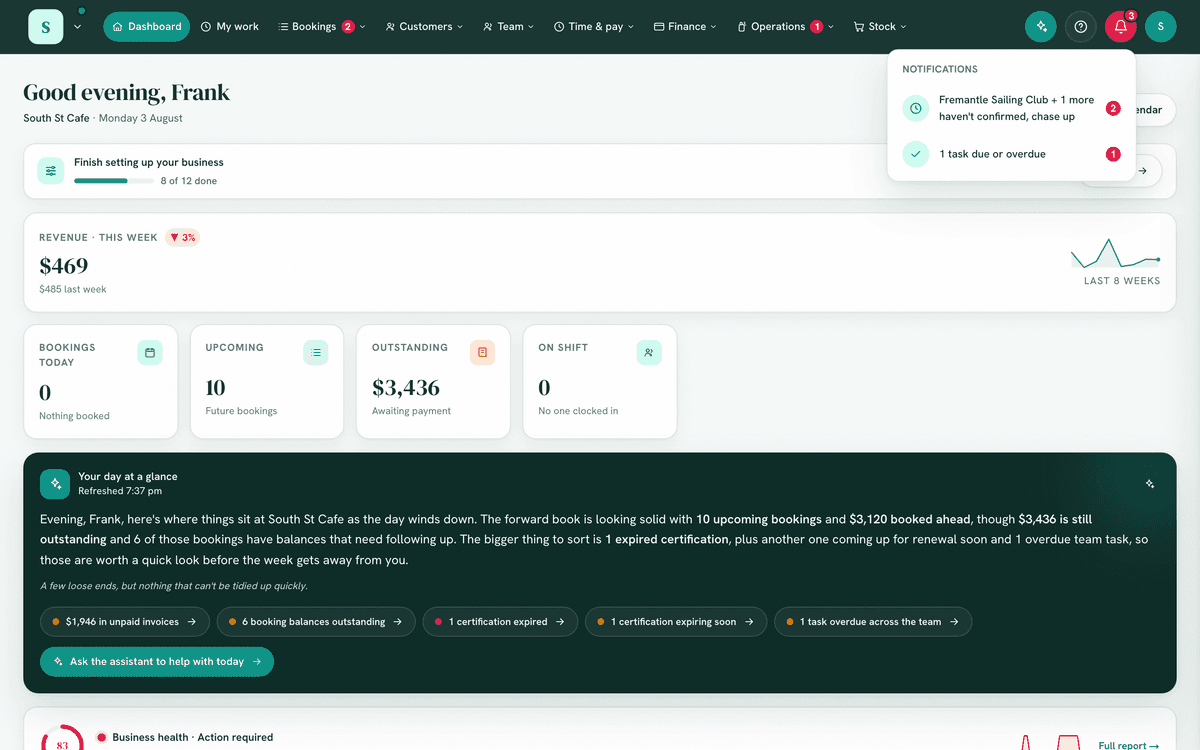
The bell shows a count when something needs you, and a panel listing items in priority order. Safety leads, because a failed check is a fridge at the wrong temperature rather than an admin chore:
- Maintenance issues to fix, and safety checks overdue today
- New customer messages
- New bookings, booking requests to approve, and unconfirmed appointments to chase up
- New members, and memberships past due
- Unread announcements, new handover notes, and new team chat (one line per channel, so you know which chat is buzzing)
- Approvals to review, and shift requests for you to respond to
- Low-rated reviews to check
- Documents awaiting your sign-off
- Tasks due or overdue, and any timesheet sent back to you
You only ever see a line for a tool your business has switched on, and only if you hold the permission for the page it links to. Each line is a shortcut to that page, and where there is a single item it names it: one open fault reads "Freezer temperature out of range, in Kitchen", not "1 maintenance issue". When there's nothing pending, it reads "You're all caught up."
The same counts appear as red badges on the menus themselves, so you can see which section is asking for you without opening the bell.
The account menu
The circular avatar (your business initial) at the far right opens:
- Your business name and tagline
- Help & getting started, opens the in-app help panel (see below)
- Account & password, change your password
- Sign out
For your security, you're automatically signed out after a period of inactivity.
Help & getting started
Every business, on any plan, including the free trial, has an in-app Help & getting started panel. Open it from the ? button on the top bar (next to the notifications bell), or from the account menu (avatar → Help & getting started). It opens as a side panel that stays put while you work, the page shifts over to make room, so you can read the step-by-step guide and click around the real screens at the same time, and it stays open as the assistant takes you from page to page. Close it with the ✕. It contains:
- Getting-started shortcuts, quick links to set up your business and branding, set up what you offer, connect payments, add your team, and view Plan & billing (links adapt to the tools you have on).
- Ask the assistant, a help chat that answers "how do I…" and "where do I…" questions and gives you a take-me-there button to the right screen.
What the help assistant can and can't do. It's a product guide, it explains the app and points you to the right place, but it cannot see your business data (bookings, money, customers, team). Ask it how and where, not how many. For answers drawn from your own live data, that's the full AI assistant (a Business-plan feature, see AI assistant). The help assistant has a monthly question allowance, set per plan (shown on the pricing/billing cards), displayed at the bottom of the panel.
The home dashboard
The Dashboard is your at-a-glance command centre. It adapts to the modules you've switched on and to your role, you only ever see cards relevant to your business.
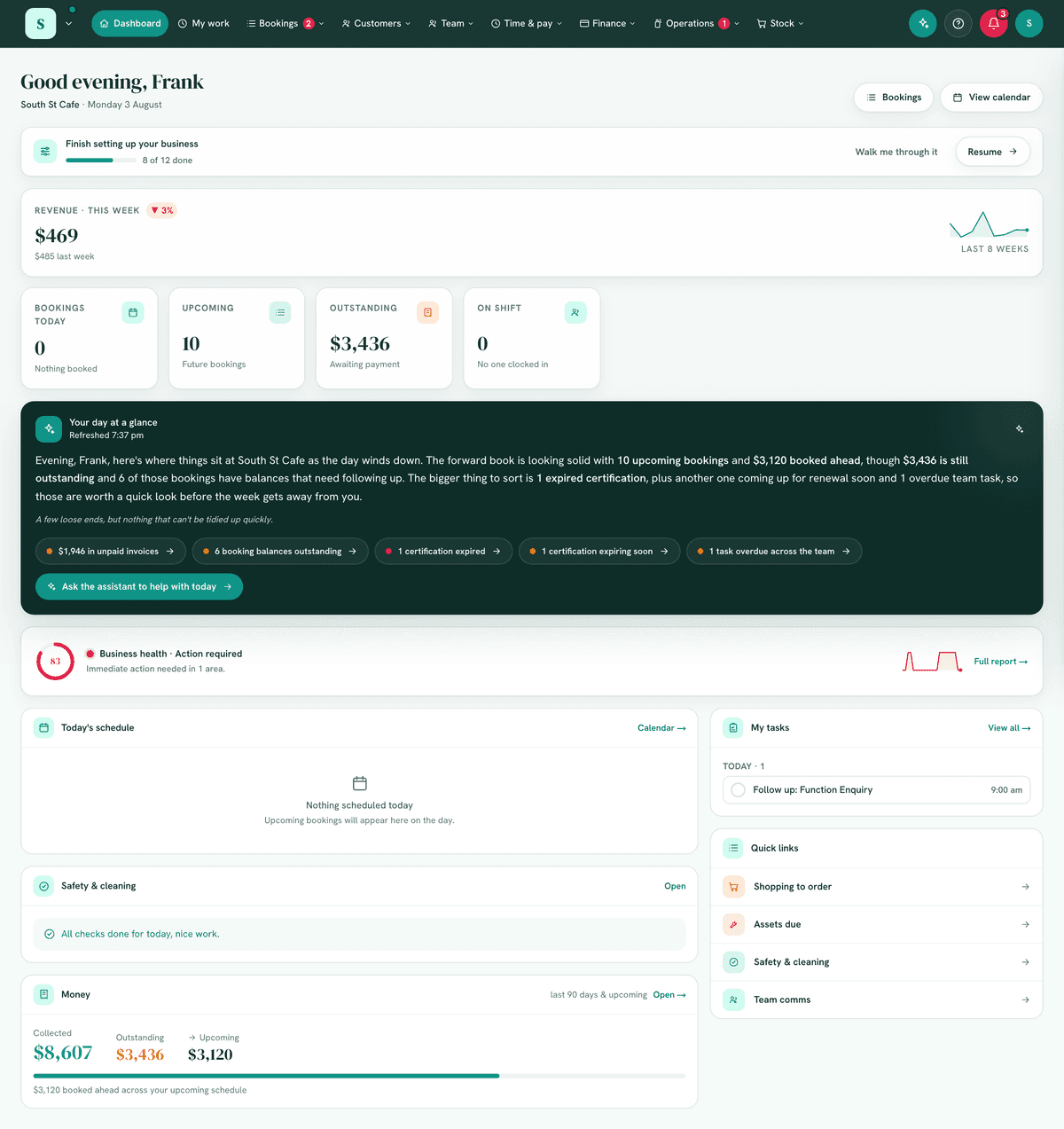
Greeting and quick actions
The top shows a time-of-day greeting with your first name, your business name and today's date. If Bookings is on, you also get quick buttons to Bookings and either Set up bookings (if you haven't yet) or View calendar.
"Finish setting up" checklist (managers only)
While you're getting started, a checklist card shows the basics of being open for business, with a live progress bar. Each step is gated to the modules you've turned on, and ticks off automatically from real data:
- Add your logo & brand colours
- Invite your team (hidden if you've marked yourself a solo operator)
- Set up what you offer (Bookings)
- Set your opening hours (Bookings)
- Connect your payment account (Money)
- Add your business & tax details (Invoicing)
- Set up your safety & cleaning checks (Safety)
- Take your first booking (Bookings)
Each step links straight to the right place. The card disappears once everything is done, or you can Dismiss it.
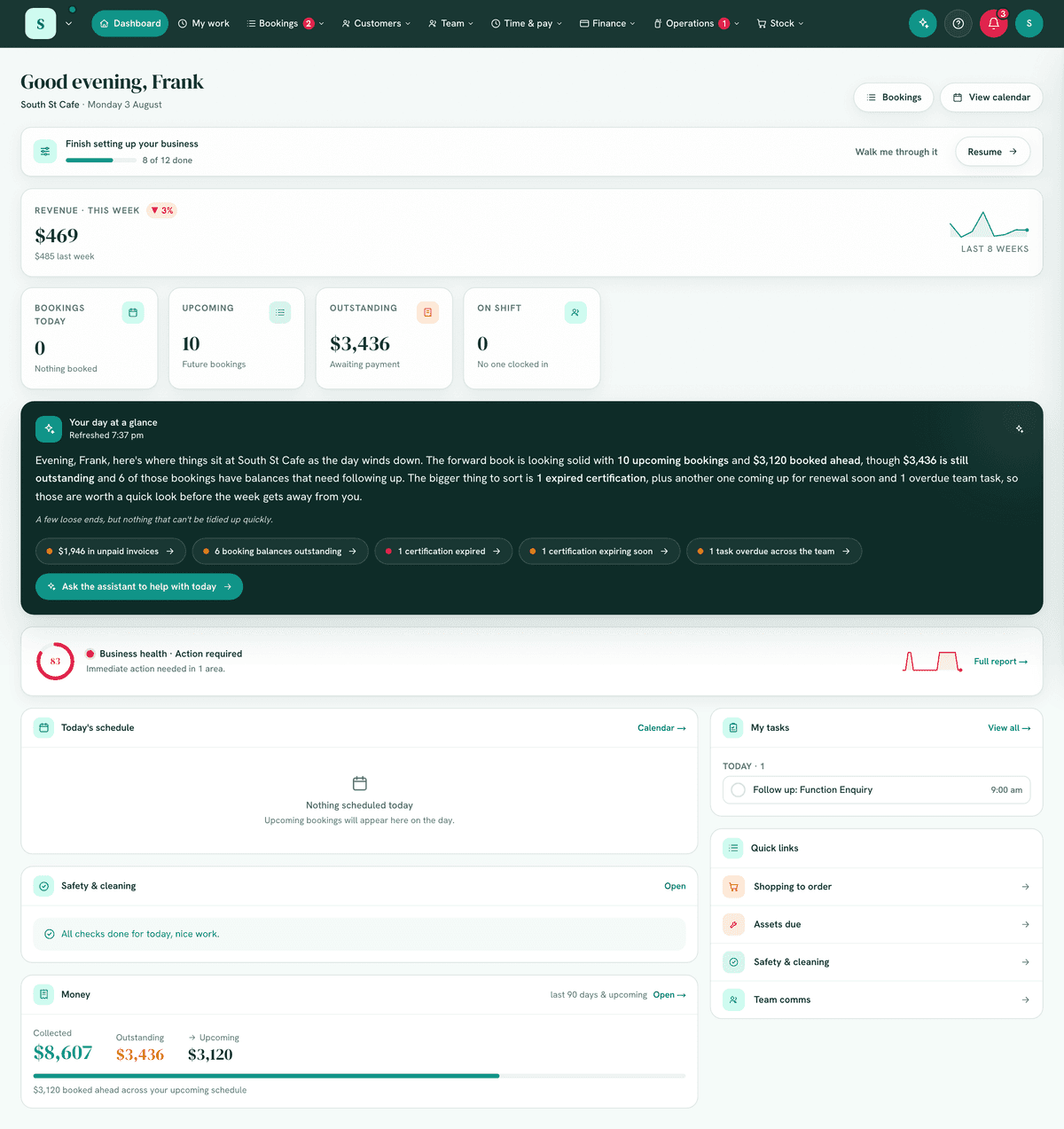
The KPI strip
Up to four key numbers, built only from the tools you use, e.g.:
- Bookings today (or your wording), what's on the schedule
- Upcoming, future bookings
- Outstanding, money awaiting payment (Money/Invoicing)
- On shift, who's clocked in now (Roster)
If you have fewer than four, a Needs attention tile fills the gap. Every tile is a shortcut.
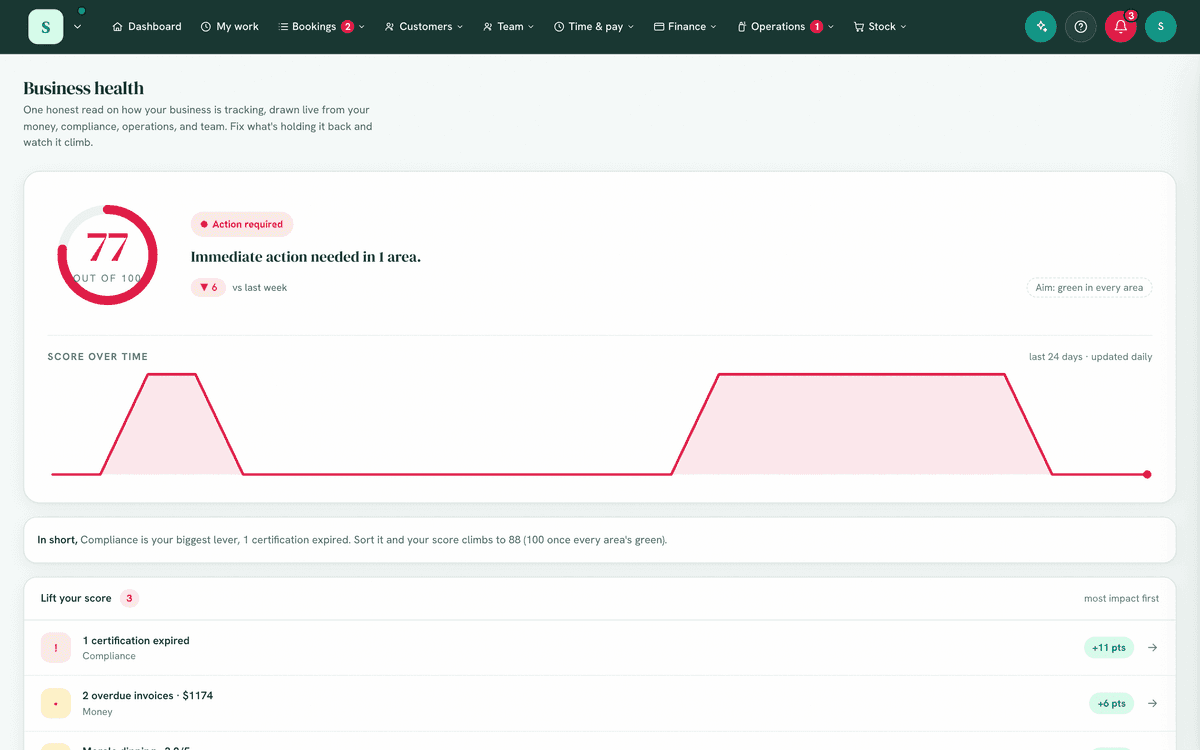
Business health (managers only)
A green / amber / red score (0-100) summarising how the business is tracking, with a one-line summary and a breakdown of areas sorted so anything needing attention leads. Select Full report for the whole picture. See Business health for what each area counts and what moves the number.
Today's schedule
A timeline of today's bookings in time order, each with who it's for, where, and a colour dot for paid (green) vs balance owing (amber). If nothing's booked, it says so.
Money
If Payments or Invoicing is on: Collected, Outstanding and Upcoming (booked-ahead value), with a progress bar showing how much of the total has been collected.
Needs attention
A cross-module to-do list, traffic-lit and linked, surfacing things like:
- Booking requests to approve
- Shift requests awaiting approval
- Unpaid invoices and outstanding balances
- Certifications expired or expiring within 30 days
- Open maintenance issues
- Assets due for service
When nothing's pending it shows All clear.
Quick links
Shortcuts to common tools you have on (Shopping to order, Assets due, Safety & cleaning, Team comms), with live counts where useful.
Common questions
"Why can't I see a menu/card a colleague has?" Either the module is off for your business, or your role doesn't have the permission. See Roles & permissions.
"The nav only shows Dashboard and Messages." This is usually a temporary session-sync glitch, sign out fully and back in. If it persists, contact your administrator.
"The dashboard looks different from this manual." It's meant to, the dashboard only shows cards for the modules you've enabled and your role.
Next: Begin the module chapters, starting with Accounting & reports.