
Module · Assets & maintenance
Where to find it in the app
- Use it: Operations → Equipment
- Turn it on/off: your business name (top-left) → Settings → Modules → Operations → Equipment & maintenance
Plan: Business · Module group: Operations · Navigation:
Operations → Equipment
1. Overview
Purpose. A register of the equipment and things your business owns or looks after, coffee machines, fridges, play equipment, gym machines, vehicles, salon chairs, tools, IT/POS gear, with recurring service schedules so nothing important slips. It tells you what's healthy, what's due soon and what's overdue, keeps a service history, and can track purchase, warranty, lease and end-of-life details. Each asset can carry a printable QR label that opens its record when scanned.
Everything is yours to name. Categories, locations, statuses and even extra
fields are all defined by your business, nothing is a fixed list. That includes
the name of the register itself: call it Equipment, Vehicles, Machines, Devices
or Tools, in Settings on this page, and your menu changes to match.
Equipment can belong to a customer. Give an asset an Owner and it becomes that customer's: their vehicle for a workshop, their pool for a pool tech, their aircon unit, boat or server for anyone who services other people's gear. It shows on their customer page, jobs can be pinned to it, its service reminders carry their name, and its record becomes the full history of everything you've ever done to it. Left blank, an asset is your own, exactly as before. You can also have HappierBiz email the owner when a service falls due, with a booking button, the switch lives in Reminders & digests (§7g) and is off until you turn it on. If the owner clicks No longer have this on that email, the record is marked Owner says they no longer have this, its reminders stop, and you decide whether to archive it, reassign it or keep it.
Your gear and your customers' gear are kept apart. The moment anything on the register belongs to a customer, the page splits into two tabs, Our equipment and Customer equipment, and everything follows the tab you are on: the counts across the top, the list, the filters, the search and the CSV export. Three things never mix, whichever tab is open:
- Total asset value is only ever your own. A customer's car is not an asset of your business, and adding it to that figure would make the number useless.
- Your Business health score counts only your own equipment. A workshop with two hundred customer vehicles on file is never marked down because other people's services are falling due.
- Your reminders stay about your business. Assets due for service and Warranty & contracts expiring cover your own gear only. Customer equipment has its own line, Customer equipment due, switched on under Remind your customers: one summary ("14 customer items due for service, 11 owners have been emailed") that opens the Customer tab, with a name listed only for an owner who could not be emailed, because that is the one to ring.
A business that never records customer equipment never sees the tabs at all.
A customer's equipment asks fewer questions, on purpose. Eight fields exist to record your purchase and your arrangements, so they are not asked for on somebody else's property:
| Not asked | Because |
|---|---|
| Serviced by, and their contact | That is the outside company you ring for your own gear. On a customer's equipment, the servicer is you. Who did each service is recorded on the service itself. |
| How acquired, Cost, Purchase date, Supplier, Order number | Your procurement record. Two of them are the customer's own financial details, which are not yours to keep. |
| Lease expiry | Their finance, not yours. |
Three fields stay, because a servicing business acts on them: Warranty until (repair or claim?), Due for replacement, and Service plan until, which on their equipment means their plan with you, and gives you a renewal reminder before it lapses.
Nothing is deleted. If a record already held purchase details when it became a customer's, they stay on the file and come back if you make it yours again.
Owner means "belongs to", not "is at". Equipment you own and leave on a customer's site is still yours: leave Owner blank and set their site as the location, so it stays in your asset value and your warranty and lease tracking.
2. When to use it
- To keep safety- or compliance-critical equipment serviced on time.
- To know where a piece of equipment is and who has it (check-in / check-out).
- To hold warranty, lease and purchase records in one place.
- To print scannable labels so staff can log a service from their phone.
3. Required permissions
- View assets (
assets.view), see the register. - Add / service assets (
assets.manage), add/edit assets, log services, manage categories/locations/statuses/fields, print labels, bulk actions.
4. Navigation path
Operations → Equipment
5. What you'll see
Two tabs, Our equipment and Customer equipment, once anything belongs to a customer. Everything below them, counts included, is about the tab you are on. In the customer tab an Owner column is always shown and cannot be switched off, because whose it is is the most important thing on the row.
A search box and a group-by selector: Smart, Category, Location, Assignee or Status.
Filters for category, location, status, service state and "expiring only." In the customer tab there is also a Customer filter, to narrow to one person's vehicles or units.
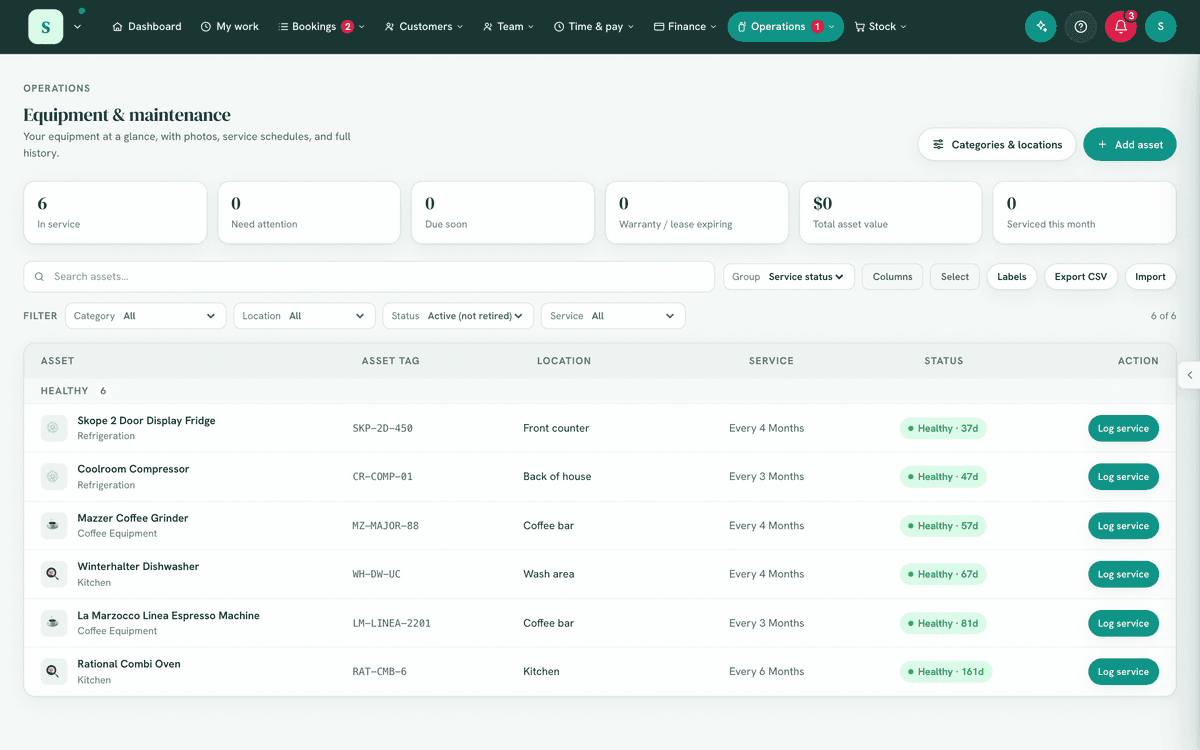
A list of assets. Each row shows a health chip and the columns your business chooses to display (tag/identifier, location, service, status), always with the asset name and an action.
A service-health chip per asset:
Chip Meaning Healthy · Nd Serviced; next service is N days away Due in Nd Due within 14 days (amber) Overdue Nd Past its service date (red) Never serviced No service recorded yet (red) No schedule No service interval set Retired Out of service Buttons to add an asset, manage your categories/locations/statuses/ fields, and (in select mode) act on many assets at once.
Opening one shows its card, and on it Faults on this: how many times this machine has been reported broken, how many are still open, and each one linking to it. That sits directly under its servicing history, because "should I replace this" needs both halves. It appears only when the machine has actually had a fault, and only if you use Maintenance.
6. Turning it on
Settings → Modules→ under Operations & compliance, switch on Assets & maintenance.- Open
Operations → Equipment. If you chose a business type at sign-up that suits it (gym, venue, salon, trades…), you'll already have starter equipment to edit.
7. Step-by-step tasks
7a. Add an asset
- Select Add asset.
- Enter the name (e.g. Espresso machine).
- Set a category and location (type your own, or pick an existing one).
- Set the service interval (e.g. every 3 months) and the last serviced date so its health can be calculated.
- (Optional) Add make/model/serial, an identifier/tag (a rego plate or serial goes well here), a photo, and acquisition details (purchased/leased/financed/donated), purchase date and cost, supplier, warranty expiry, lease expiry and end-of-life date.
- (Optional) Set an Owner to record it as a customer's equipment. You can also start from the customer's own page: Their equipment → + Add opens this form with them already picked.
- Save.
Expected result: the asset appears in the list with a health chip based on its interval and last-serviced date. Customer-owned equipment shows the owner's name, and an Owner filter (and list column) appears once anything is owned.
7b. Log a service
- Open the asset (or scan its QR label).
- Choose to log a service.
- Set the date, who serviced it, an optional note and cost.
- Save. The asset's last serviced date updates and its health chip turns green; the service is added to its history.
7c. Print & use QR labels
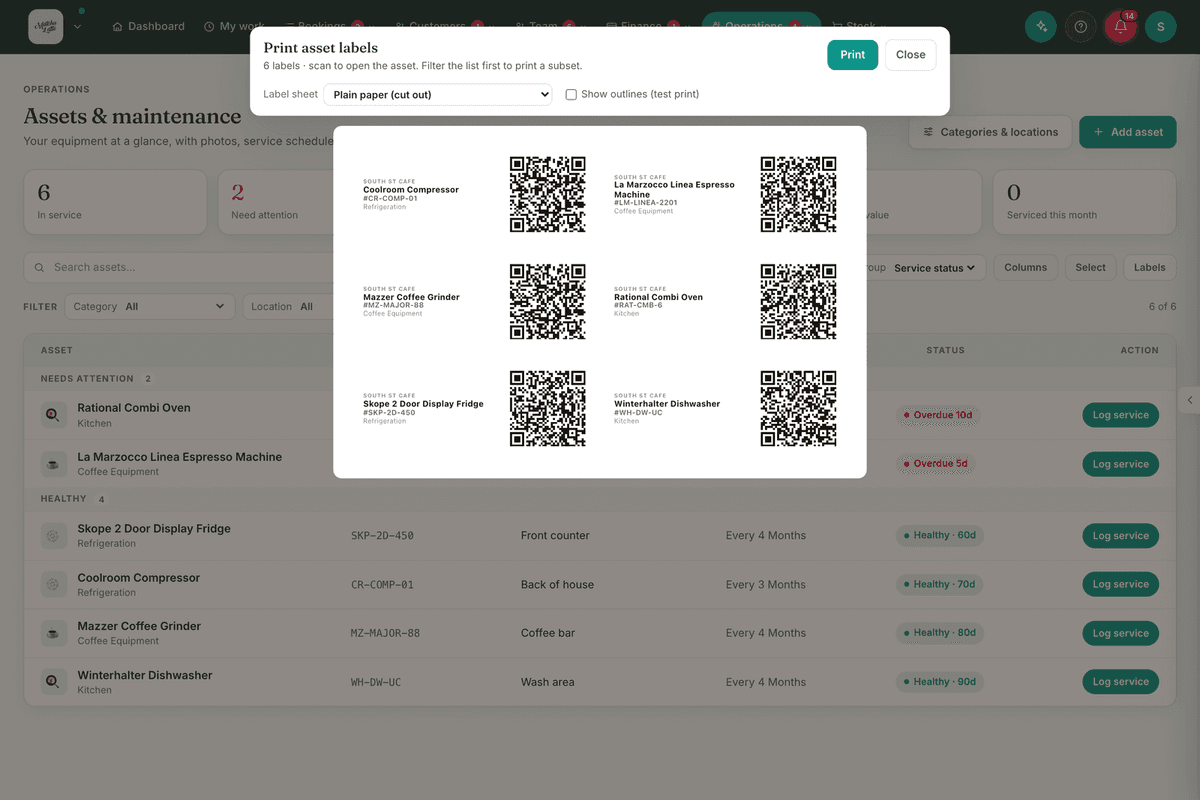
- Tick one or more assets (select mode) and choose print labels, or open a single asset and print its label.
- Stick the label on the equipment.
- Scanning the label opens that asset's record directly, ready to log a service or check it out.
7d. Check an asset out / in
- Open the asset.
- Check out to a person (staff assignee) with an optional note when it leaves; check in when it returns.
- The asset shows who currently holds it; the history records each movement.
7e. Change status / retire
- Open the asset (or select several).
- Set its status, e.g. In use, In storage, Under repair, Retired, Lost / stolen (or your own statuses).
- Retired and Lost / stolen assets are hidden from the default view (switch the status filter to All to see them) and stop showing service reminders.
7f. Customise lists & fields
- Choose Manage.
- Add/rename categories (with a default service interval), locations, and statuses (each status has a behaviour: serviceable or not, hidden or not).
- Add custom fields (text, number, date or choice list), e.g. Rego, Engine no., Fuel type. Date fields show a relative-expiry chip like warranty/lease.
7g. Bulk actions
- Turn on select mode and tick several assets.
- Apply an action to all of them: print labels, change status / retire, move category or location, or delete.
8. Examples
Beginner. A café adds its Espresso machine with a monthly service interval and today's date as last serviced. It shows Healthy · 30d. A month later it flips to Overdue until someone logs the service.
Real-world business. A party venue tracks its soft-play frame, PA system and projector, each on its own schedule. The dashboard's Assets due shortcut and the Reminders digest flag anything overdue before the weekend's parties.
Advanced. A trades business adds a custom Rego date field and a Fuel type choice list to its Vehicle category, records purchase cost, warranty and lease expiry for each ute, prints QR labels for the toolkits, and checks tools out to apprentices each morning, all visible in the history.
9. Reports & exports
- Service history per asset (date, who, note, cost).
- Health view across the register (overdue / due-soon / never-serviced), filterable and groupable.
- Export CSV writes whatever is on screen, so it follows the tab and any filters you have set. The first column is Owner, either Ours or the customer's name, so the file is safe to hand to an accountant or an insurer without them having to guess whose is whose.
- Import never sets an owner. A spreadsheet can only give you a name, and ownership is a link to a real customer record, so an Owner column in a file you import is read and reported but deliberately not applied. Anything already on the register keeps the customer it has.
- Your own overdue equipment feeds the dashboard, Business health and the Reminders & digests module. Customers' equipment feeds the morning digest only, by name.
10. Common mistakes
- No last-serviced date → the asset reads Never serviced (red) even if it's fine. Set the date when you add it.
- Interval of 0 / blank → No schedule; it will never remind you. Set an interval for anything that needs regular servicing.
- Looking for a retired asset and not finding it, switch the status filter to All.
- Typing a new category for every asset by accident, pick from your existing ones to keep the list tidy.
11. Troubleshooting
| Problem | Fix |
|---|---|
| An asset I added is missing | Check your filters (category/location/status/"expiring only") and search box, clear them. |
| Health chip says "Never serviced" | Log a service, or set the last serviced date on the asset. |
| Managed lists / custom fields / check-out don't appear | These rely on optional database updates; if they're missing entirely, ask your administrator whether the latest updates are applied. The core register still works. |
| Scanning a label does nothing | Ensure you're signed in to the back-office on the scanning device; the label opens the asset within your workspace. |
| Overdue items not in my digest | Confirm the Reminders & digests module is on and you've opted into asset reminders. |
12. Error messages
The Assets screen works inline (toasts like "
Related: Maintenance · Safety & cleaning · Reminders & digests